You topped off the pool on Sunday, and by Wednesday the water is back down below the tile line. So you add the hose again. In a New Braunfels summer, it is easy to shrug this off as the heat, and a lot of the time that is exactly what it is. But there is a nagging question you cannot answer just by looking: is the pool drinking that water into the air, or is it quietly leaking it into the ground?
The difference matters more than it seems. Water that leaves as evaporation is normal and cheap to replace. Water that leaves through a leak takes your chemicals and your money with it, dilutes the pool so algae gets a foothold, softens the soil around the shell, and only gets worse the longer it runs. Worst of all, an automatic fill line can hide the whole thing, so the water level looks fine while the leak keeps working and your bill keeps climbing.
The good news: you do not have to guess. One bucket and 24 hours will tell you which one you are dealing with, and this guide walks you through the exact test, how to read it, and how to tell roughly where a leak is hiding before you ever call anyone.
First, Know What “Normal” Looks Like Here
Every pool loses water to evaporation, and Hill Country summers are built to speed it up. Evaporation climbs with four things working together: high air temperature, low humidity, wind, and warm water. New Braunfels serves up all four at once for months, so our pools evaporate faster than the numbers you read on national blogs.
As a working range, a quarter to a half inch of water loss per day is normal here in peak summer. At the high end that is roughly three and a half inches over a week, which for an average backyard pool can be well over a hundred gallons on a hot day. That is not a leak. That is a Texas July doing what it does.
The Bucket Test, Step by Step
The bucket test is the honest way to separate evaporation from a leak, because it measures both under the exact same weather. A bucket of pool water can only lose water to evaporation. Your pool loses water to evaporation plus any leak. Sit them side by side for a day and the pool tells on itself.
- Pick a stretch of dry weather and a time the pool will not be used. Turn off any automatic fill device so it cannot top the pool off mid-test.
- Set a five-gallon bucket on the second step so it sits in the water. If the step is too high, use a lower step and put a brick or spacer under the bucket.
- Fill the bucket with pool water until the inside level matches the pool level around it, as close to the top of the bucket as you can get.
- Mark the water level on both the inside and the outside of the bucket with a permanent marker or a piece of tape.
- Leave everything alone for 24 hours with the pump running normally. Do not swim, backwash, drain, or add water during the test. If it rains, stop and start over on a dry day.
- At the 24-hour mark, compare the two marks. If the pool dropped about the same as the bucket, you are looking at evaporation. If the pool dropped noticeably more than the bucket, you have a leak.
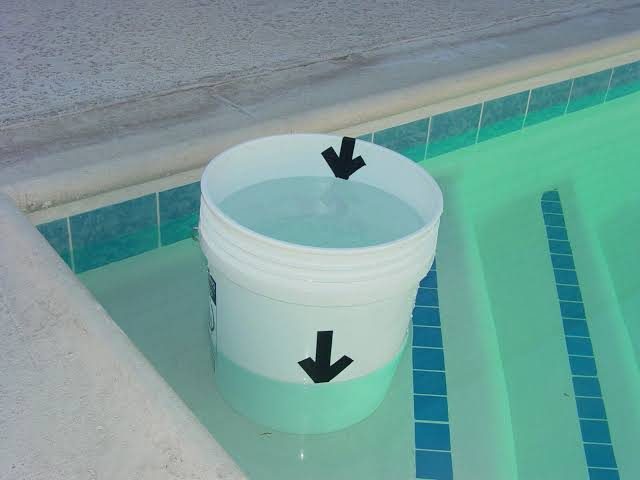
How to read the bucket test
Both sat in the same sun for 24 hours
SAME DROP = EVAPORATION
POOL DROPS MORE = LEAK
Dashed line = starting level. The gap the pool loses beyond the bucket is your leak.
Standard bucket-test method used across the pool industry. Run it during a period of non-use with the circulation system running.
Is It Only Losing Water When the Pump Runs?
Once the bucket test says leak, a second, simpler test tells you roughly where. Run the bucket test again, this time with the circulation system turned off, and compare.
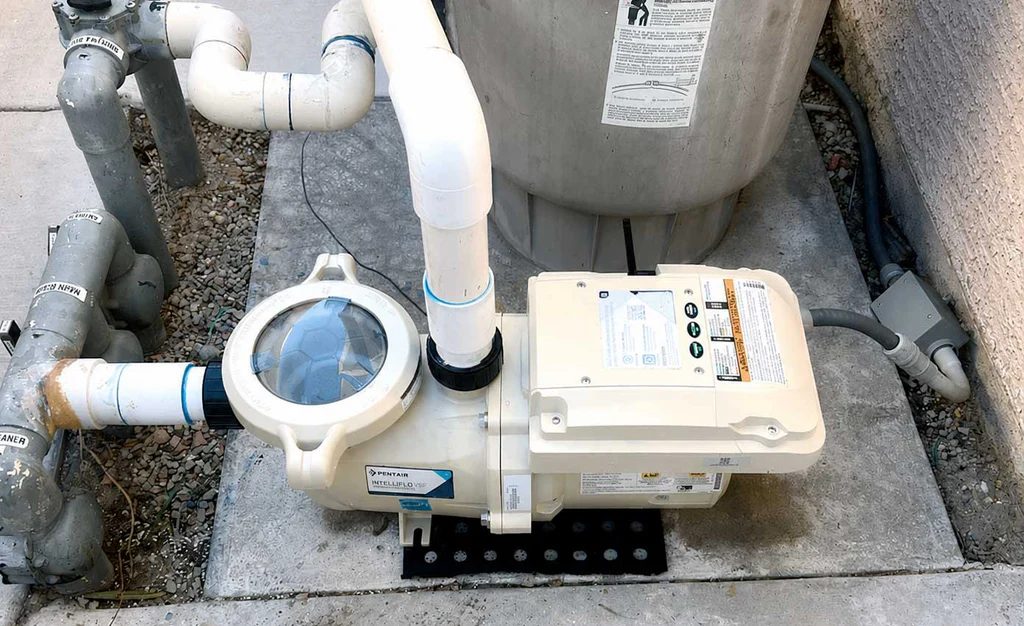
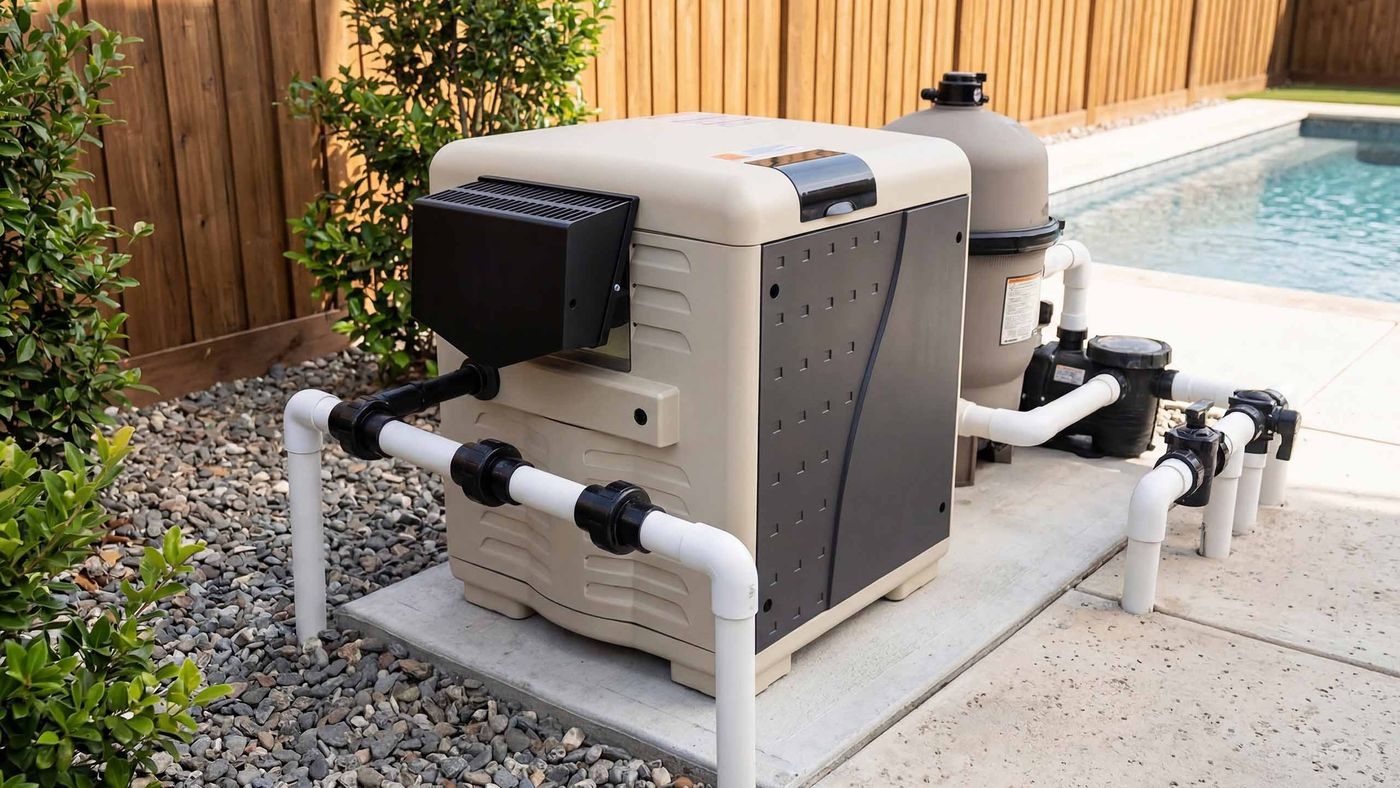
- Leaks only when the pump is running (levels stay even with the pump off): the leak is most likely in the circulation system, the pressurized return plumbing that only holds water when the pump pushes it. Underground return lines, the equipment pad, and pipe joints are the usual suspects.
- Leaks even with the pump off (the pool keeps dropping while everything is shut down): the leak is most likely in the pool structure itself, the shell, a fitting, the main drain, or the skimmer, where gravity pulls water out regardless of the pump.
- Loses about the same either way: that points toward the shell or a fitting rather than the plumbing, and it is worth a professional look.
You do not need to fix anything based on this. Knowing whether the loss follows the pump is simply the single most useful clue you can hand a leak detection tech, and it can shorten the visit.
Other Signs It Is a Leak, Not the Heat
The bucket test is the proof, but these everyday signs often show up first and are worth watching for:
- An unexplained jump in your water bill, or an autofill that seems to run constantly.
- Water balance that will not hold, so you are always chasing chemistry as fresh fill water dilutes the pool.
- Air bubbles pushing out of the return jets, a classic sign of a suction-side leak drawing air into the plumbing.
- Loose or popping tiles, or a section of deck that has cracked or settled.
- A soggy, always-wet patch in the yard, or plants near the pool thriving or dying from the extra water.
- A persistent wet spot at the equipment pad, or drips from a multiport valve.
None of these alone proves a leak, but a couple of them together, plus a failed bucket test, is a strong case.
Evaporation vs. Leak, at a Glance
| Evaporation | A leak | |
|---|---|---|
| Rate | About 1/4 to 1/2 inch a day in peak summer | More than roughly 2 inches a week, often faster |
| Pattern | Worse on hot, dry, windy days; eases when it is cool or humid | Steady loss regardless of weather, even on mild days |
| Bucket test | Pool and bucket drop the same | Pool drops more than the bucket |
| Clues | None beyond the water line | Wet spots, popping tiles, deck cracks, air in returns, rising bill |
| Fix | Top it off; a liquid solar cover slows it | Locate and repair the source, or call for leak detection |
What You Can Check Yourself, and When to Call a Pro
The bucket test and the pump on-versus-off comparison are both fair DIY jobs, and they answer the big question of whether you even have a leak. You can also eyeball the easy stuff: the equipment pad for drips, the backwash line to be sure it is not weeping to waste, and the skimmer throat for an obvious crack.
Where it pays to call is finding and fixing an actual leak. Pinpointing a break in an underground return line or a hairline crack in the shell without tearing up the deck takes pressure testing and specialized listening gear. That is the territory of professional leak detection and pool repair. If the loss tracks with the pump, the plumbing is the focus, which may point to pump and equipment-pad repair or a return-line fix. If a dirty filter or a weeping multiport valve turns out to be the culprit, that is a filter repair rather than a true shell leak. And keeping the filter clean and the water balanced, which good filter care covers, makes any real leak far easier to spot early.
Not sure if it is the heat or a leak?
Poncho’s can run the test, track down the source, and fix it, so you stop pouring water and money into the ground. Serving New Braunfels and Comal County.
Get a Free Leak Check